Osun 2026: Jobs, Infrastructure, Reform Core Of Oyebamiji’s Agenda
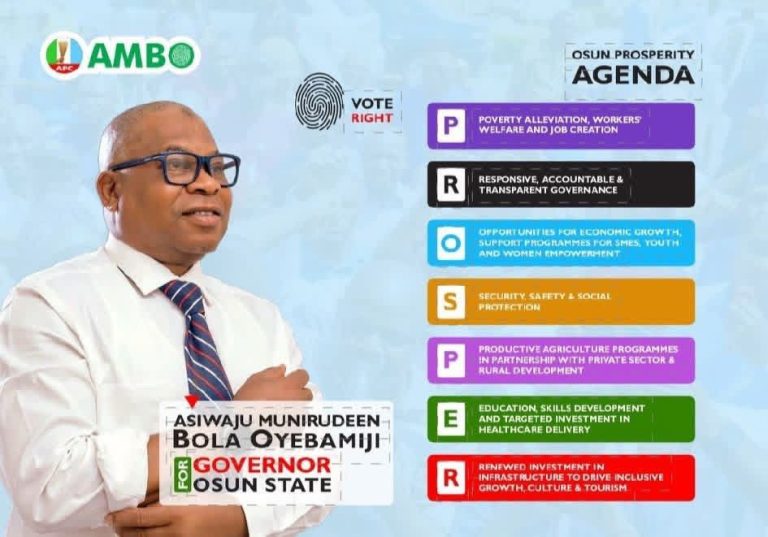
On Friday, May 1, 2026, the governorship candidate of the All Progressives Congress (APC) for the August 15 election, Asiwaju Munirudeen Bola Oyebamiji, unveiled his manifesto, setting out what he described as a “pact” with the people of Osun. In this report, …….. examine how the APC flagbearer aims to steer the state away from mounting challenges and reposition it on a path to stability and prosperity.>

As political activities gather momentum ahead of the next governorship election in Osun State, the candidate of the APC, Asiwaju Munirudeen Bola Oyebamiji (AMBO), has unveiled an ambitious manifesto he says will reset the state’s development trajectory.
Branded “My Pact With Osun People,” the document lays out a broad reform agenda anchored on transparency, economic revitalisation, and social welfare. But beyond the promises, the manifesto also throws into sharp relief growing criticisms of the incumbent administration led by Governor Ademola Adeleke, particularly in key sectors such as healthcare, education, and agriculture.
Speaking at a well-attended launch that drew stakeholders from across public and private sectors, Oyebamiji framed his agenda around a seven-point development blueprint captured in the acronym P-R-O-S-P-E-R.
According to him, the APC government under his leadership would prioritise poverty reduction, workers’ welfare, job creation, security, and infrastructure renewal.
“We are prepared to return Osun to the path of growth, prosperity and abundance,” he declared, promising a government defined by accountability and citizen-focused policies.
Central to his economic vision is the revival of strategic assets such as the Dagbolu Dry Port and the Ido-Osun Aviation City, alongside renewed investment in small businesses, industrial parks, and the Osun Free Trade Zone.
A Failing State Under Adeleke
Oyebamiji’s policy prescriptions come against a backdrop of increasing scrutiny of the Adeleke administration’s performance.
In the health sector, stakeholders have raised concerns over underfunded primary healthcare centres and persistent shortages of medical personnel. Osun, rural communities have been particularly affected, with many facilities lacking essential drugs and equipment.
A severe shortage of personnel plagues primary health centres (PHCs) in Osun State, with reports indicating that 44% of facilities operate without a single health worker.
According to the data, 73 per cent of PHCs in Osun State operated with zero to one health worker. In comparison, 44 per cent had no workers at all, meaning nearly three out of every four facilities are unable to provide basic healthcare services.
Beyond manpower shortages are infrastructural deficiencies across many centres. Several PHCs were found to lack clean water, functional toilets and basic hygiene materials, making effective patient care extremely difficult.
It further revealed that in many facilities, nurses and patients depended on well water or other unsafe sources for deliveries, sterilisation and hand-washing, raising concerns about infection control and patients’ safety.
According to the National Primary Health Care Development Agency (NHPCDA), the minimum standard for PHCs in Nigeria should include a minimum of 10 workers, who include a doctor, nurses/midwives, community health officer, CHEW, pharmacy technician, Junior CHEW, environmental officer, medical records officer and laboratory technician.
However, public health experts have warned that the persistent understaffing of PHC has far-reaching consequences for individuals, communities and the overall health system in Osun State.
This is because the severe shortage has forced some facilities to operate part-time or close entirely, limiting access to essential services like prenatal and maternal care
Budget data reports also suggest that health spending in Osun, remains below the 15% benchmark recommended under the Abuja Declaration.
Critics argue that without significant capital investment, outcomes such as maternal mortality, may remain difficult to reverse in the State.
In education, the challenges are equally stark. While Osun has historically maintained relatively high school enrolment rates compared to some northern states, infrastructure deficits and teacher shortages persist. Reports indicate overcrowded classrooms in public schools, with pupil-to-teacher ratios in some areas exceeding 50:1, undermining learning outcomes.
The UNESCO estimates that Nigeria still has over 10 million out-of-school children, and Osun hasn’t fared better on the national average and concerns remain about declining quality of education and inadequate investment in technical and vocational training.
The agricultural sector that was once a backbone of Osun’s economy, has also faced headwinds. Smallholder farmers, who make up over 70% of Nigeria’s agricultural workforce, continue to grapple with poor access to credit, mechanisation, and markets.
Analysts note that despite Osun’s fertile land and favourable climate for crops such as cocoa and cassava, productivity remains low.
For instance, data from the National Bureau of Statistics (NBS), show that agriculture contributes significantly to employment but less efficiently to GDP due to low yields and post-harvest losses, estimated at up to 30-40% annually.
Critics of the current administration argue that limited policy coordination and slow execution of agricultural programmes have prevented the state from fully leveraging its potential.
AMBO’s Counter-Promise: A Turnaround Strategy
Oyebamiji says his administration will address these gaps head-on.
In healthcare, he pledged to recruit more medical personnel, upgrade primary health centres, and expand access to affordable services.
On education, he promised investments in modern learning infrastructure, teacher recruitment, and expanded vocational training aimed at aligning skills with labour market demands.
For agriculture, his plan includes the establishment of agro-industrial clusters, modern farm settlements, and improved access to financing and technology for farmers. He also pledged to remove bottlenecks in land acquisition to encourage agribusiness investment.
“We will harness agriculture not just for food security, but as a major driver of economic growth,” he said.
The Stakes For Osun
With a population estimated at over 4 million people, Osun remains a largely agrarian state with significant untapped economic potential. Yet like many subnational economies in Nigeria, it faces fiscal constraints, rising unemployment, and infrastructure deficits.
The contest between Oyebamiji and the incumbent administration is shaping up as a referendum not just on personalities, but on governance outcomes and policy direction.
For many residents, the key question is whether the next administration, whoever leads it, can translate the huge monthly allocations from the federal government into prosperity and promises into measurable improvements in living standards.
As the campaign season gathers momentum, Oyebamiji’s “Pact” does more than outline policy intentions, it reframes the election as a defining moment for Osun’s future.
At stake is not abstract political power, but the lived realities of citizens: the quality of classrooms where children learn, the reach and reliability of healthcare services, the productivity and profitability of farms, and the broader direction of an economy searching for stability and growth.
Currently, the debate has shifted beyond party lines to questions of competence, execution, and vision. Consequently, the critics of the Ademola Adeleke administration argued that the pace and depth of reforms of the current administration have fallen short of the state’s urgent needs.
Within this context, Oyebamiji’s candidacy is positioned as a potential inflection point. Drawing from his experience across both public and private sectors, his technocratic approach, emphasis on accountability, and structured development agenda would offer the clarity and direction Osun currently lacks.
Ultimately, as the 2026 governorship race shapes up, it is not merely a political contest, but putting an end to lacklustre performance, misplaced priorities and restoring lost confidence in the machinery of governance.














Post Comment